University Tuition Online: Engineering, Accounting, Finance and Computing
Online tutoring for university students in Malaysia, in the engineering, accounting, finance, analytics and computing courses that decide a degree.

Founder & Head of School, Afterkelas
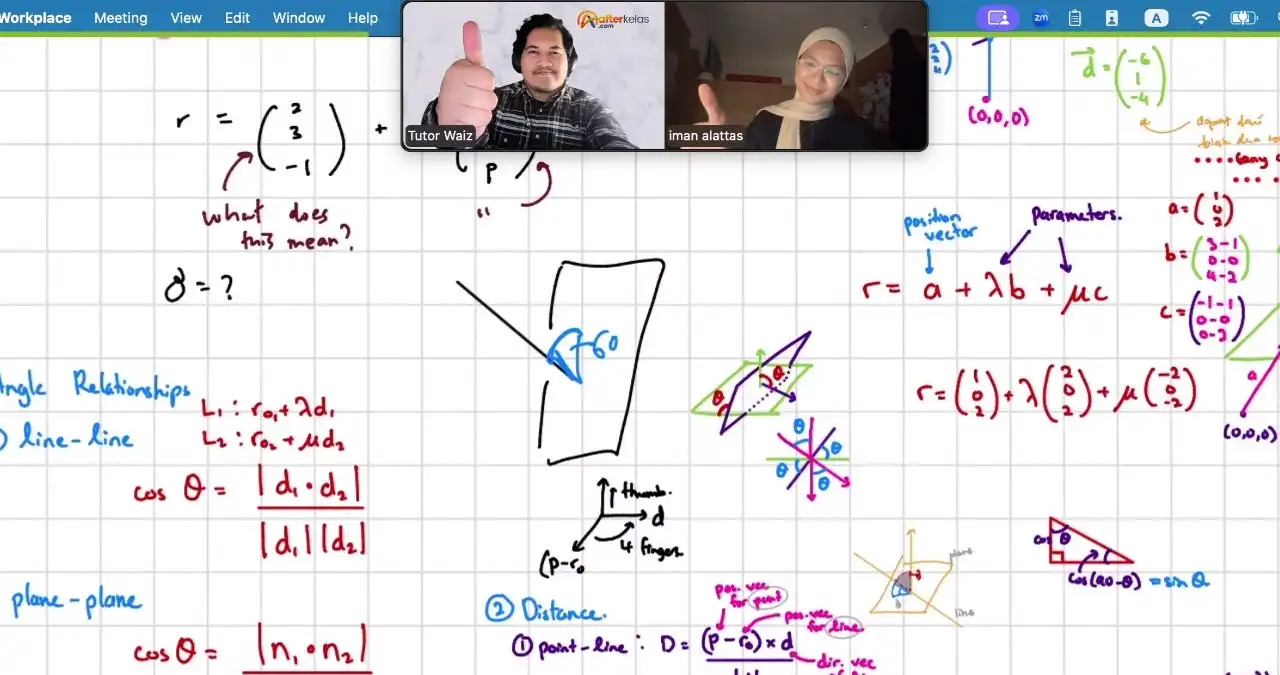
Afterkelas tutors university students online in degree courses such as Engineering Mathematics, Thermodynamics, Fluid Mechanics, Corporate Finance, Financial Accounting and Programming. Tutors run live sessions, 1-to-1 or in small groups, working from the student's own course outline.
Subjects we teach at degree level
For engineering students we teach Engineering Mathematics, Thermodynamics, Fluid Mechanics and Material Science; for computing and analytics students, Programming, Computer Science, Data Analytics and Business Insights; for business and accounting students, Corporate Finance, Financial Accounting and Reporting, and Managerial Accounting. Each subject has its own page with its core topics and a worked problem.
Engineering Mathematics for degree and diploma students: calculus, differential equations, Laplace transforms, matrices, vector calculus and Fourier series, taught from your course outline.
Engineering Thermodynamics: properties and steam tables, the first and second laws, entropy, and the power and refrigeration cycles, taught from your course outline.
Fluid Mechanics for degree and diploma students: fluid statics, continuity, Bernoulli and momentum, dimensional analysis, pipe flow and losses, taught from your course outline.
Materials Science and Engineering for degree students: bonding and crystal structures, defects, mechanical properties, phase diagrams, heat treatment and the main classes of materials.
Programming for degree and diploma students in C, C++, Java or Python: from variables, selection and loops to functions, arrays, objects and recursion.
Computer Science degree courses: data structures and algorithms, discrete mathematics, computer architecture, operating systems, databases, networks and theory of computation.
Data analytics for degree students: cleaning and exploring data, statistics and regression, visualisation and an introduction to machine learning, in Excel, SQL, Python or R.
Business Insights and business analytics courses: turning business data into findings and recommendations, with KPIs, spreadsheets, dashboards and clear writing.
Corporate Finance for degree students: time value of money, bond and share valuation, capital budgeting, risk and return, cost of capital and capital structure.
Financial Accounting and Reporting
Financial Accounting and Reporting for degree students: the Conceptual Framework and the MFRS standards on inventories, property, revenue, leases and more, through to group accounts.
Managerial and cost accounting for degree students: cost behaviour, job, process and activity-based costing, CVP, budgets, variances and decision-making.
Your course, not a generic one
University courses are written by each faculty, so the same subject name can cover different topics, in a different order, at two universities. Tutors start from the course outline, the lecture slides and past assessments, and teach to that course's assessment: tutorials, lab reports, quizzes, tests and the final exam.
The subject pages list the core topics of each discipline as a shared map. The course outline decides the depth.
Assignments and academic integrity
University assignments, lab reports, projects and code are assessed as the student's own work, and universities treat outside help with them as misconduct. A tutor explains the concepts and methods behind an assignment and works through similar problems, but does not write, code or complete any part of assessed work.
That line also matches what helps most: the final exam tests the same understanding, without notes or help.
When tuition helps most
Tuition helps most in the first weeks of a demanding course, before mid-semester tests, and when a failed course has to be retaken. A university semester covers its content in about fourteen weeks of teaching, so a student who starts early has room to fix gaps before they are tested.
A question, worked through
A first-year calculus problem of the kind engineering, computing and analytics courses all build on: integration by parts on a definite integral.
Question
Evaluate ∫₀^(π/2) x cos x dx.
- Choose u = x, so du = dx, and dv = cos x dx, so v = sin x.
- Integration by parts: ∫ x cos x dx = x sin x − ∫ sin x dx = x sin x + cos x + C.
- Apply the limits: [x sin x + cos x] from 0 to π/2 = (π/2 × 1 + 0) − (0 + 1).
- The integral equals π/2 − 1, about 0.571.
Answer π/2 − 1 ≈ 0.571.
Frequently asked questions
Do you teach my university's course?
Yes, where the subject is one we cover. The tutor works from your course outline, lecture notes and past assessments, so classes follow your syllabus and your assessment dates.
Can a tutor do my assignment or coding project?
No. University assignments, lab reports and projects are assessed as your own work. The tutor explains the concepts, works through similar problems and checks your understanding, which is also what the final exam tests.
Do you help students who failed a course?
Yes. A retake is a good time for tuition: the tutor finds the topics that cost the most marks, rebuilds them from the start and practises the question types from past papers.
Are classes in English or Bahasa Melayu?
Classes follow the language your course is taught and examined in, English or Bahasa Melayu, and tutors can explain in either.
Can I book help for just one test?
Yes. Some students book a few sessions before a test or final exam; others take weekly classes for the whole semester. The advisor suggests a plan after seeing the course outline.
How much does university tuition cost?
The fee depends on the format (1-to-1 or a small group), how many classes a week and the tutor, so there is no single figure. Send an academic advisor the university, the course code and the course outline on WhatsApp, and you will get the current packages and a quote, usually within one working day.